Saturday, January 28, 2012

I Am Iron Lady (Streep Re-Mix)

When producing a modern biopic filmmakers have to answer several questions. How much do they assume is common knowledge to the audience?  Should they concentrate on one major event or go the full Monty and attempt to tackle the subject's entire life? 


There are really only a handful of effective biopics. Films like "The Aviator,"  "Capote" and "Milk" work well because the filmmakers approach their subjects as film characters. This allows that the freedom to work from the inside out, rather than concentrating on complete accuracy. Other films like"Patton" and "Ed Wood" work because there is an unknowable quality to these figures that the filmmakers opt not to question.  Rather, they stand back and let us try to figure them out for ourselves.

Unfortunately, for every biopic that works, there are probably five that don’t.  For every "Ed Wood", there are two "Beyond the Sea." These films objectify the subject without delving too deep leading to a shallow almost exploitative viewing experience.  The filmmakers simply want to trade on their subjects’ recognizably, rather than actually saying something about them.

Phyllida Lloyd’s "The Iron Lady" is not totally in the latter camp, but is certainly not in the former.  In telling the story of British Prime Minister Margaret Thatcher, Lloyd displays an eye for detail and tone that effectively creates a political world that is an impenetrable bureaucracy.  The men at the heart of British government in the 1970s and 80s are portrayed as stubborn bulldogs. They’ve been doing this the same way for years and they just going to keep on doing it that way until they die.  In the midst of this comes a strong-willed, independent woman, who fights her way into the boys club and quickly takes charge. It is to Lloyd’s credit that the lead up to Thatcher’s reign is exciting and effective.  When telling the story of an important political figure, few things are more important than creating a strong context.  We need to get a sense of where and when this person lived, so that we might better understand how they might have decided to take certain actions.  Lloyd manages to go against the standard biopic stereotype and manages to tell a good portion of the story visually, rather than simply have characters sit around in a medium shot explaining everything to the audience.

Unfortunately, once Thatcher takes office, the film devolves into a story we’ve seen countless times before, albeit with the genders reversed.  Once again, the familiar trope of the unappreciated spouse complaining about not being a priority gets trotted out and we are given some token introspection from Thatcher.  Also, many of the specific achievements that Thatcher obtained while in office are skimmed over.  Perhaps Lloyd found the simple fact of Thatcher’s election to be inspiring enough.  Maybe she didn’t feel comfortable really delving into a figure as divisive as the conservative Prime Minister. Whatever the director’s reason, I think it is a major mistake to retreat from Thatcher's ideals. There are a few scenes when the audience is given a sense of this woman’s convictions, whether we believe in them or not, and these scenes are stirring.  There is the moment when she decides to go to war to defend the British territories, even though she is under tremendous pressure to simply let them go.  As we see Thatcher stand up to her advisers and even the American ambassador, we really start to feel like we’re seeing the real Thatcher in action, rather than a quick series of reenactments.

Ultimately, the choice to make a film about Margaret Thatcher at all is an interesting one.  Thatcher is a controversial figure, and there is no doubt a great film to be made about her.  Unfortunately, Lloyd and her screenwriter seldom seem very interested in going very deep into her character.

As with any biopic, good or bad, the vital element of the film is the lead performance.  And, thankfully, Meryl Streep displays a commitment to crafting not only a physically and behaviorally accurate performance, but one of substance.  Like so many other actors in these types of roles, Streep could have relied heavily on the exterior of the character; the part we are all familiar with.  Instead, much like Phillip Seymour Hoffman in "Capote", Streep creates a full-fledged, three-dimensional character with hopes, dreams, and fears.  Only after the character is finished does Streep layer on the cosmetic qualities.  

It has become such a standard position that Meryl Streep is a great actress that we sometimes forget why we think that.  Her performance here reminds us. At every level, she is committed to the performance.  She puts forth a great amount of effort into the role while making it all look so easy.  It would have been enough for her to skate through this role, throw on an accent, sound commanding, then go home.  But she doesn’t.  She invests herself in the role.  While watching the film, I not only forgot that I was watching Meryl Streep; I forgot that I was watching “The Best Actress of Her Generation.”  I wasn’t even thinking in those terms.  I was simply watching Margaret Thatcher.

It is Streep’s committed performance that makes me wish there was a better film surrounding her. She certainly elevates the film- along with the sturdy support of Jim Broadbent- but there is only so high it can go when it seems only superficially interested in its subject. Ultimately, the choice to make a film about Margaret Thatcher at all is an interesting one.  Thatcher is a controversial figure, and there is no doubt a great film to be made about her.  Unfortunately, Lloyd and her screenwriter seldom seem very interested in going very deep into her character

Saturday, January 7, 2012

Seventies Spy


Director Tomas Alfredson's adaptation of John le Carre's "Tinker Tailor Soldier Spy" is an uncommon movie going event. A intelligent, complicated film that requires attention and patience from the audience. It's the kind of movie we're always hearing they don't make anymore, until they do. And here it is.

The story is pretty standard stuff; a mole has infiltrated the highest levels of British intelligence, and must be flushed out. "There's a rotten apple," the agency head, known only as Control (John Hurt), tells his agent, Jim Prideaux (Mark Strong). "We have to find it." And with that, he dispatches Prideaux to Budapest to get the mole's name. The agent is promptly shot. Control is dismissed, but after his death, his deputy George Smiley (Gary Oldman) is asked to investigate the mole. He narrows it down to four men: new agency head Percy Alleline (Toby Jones) and his deputies Bill Haydon (Colin Firth), Roy Bland (Ciaran Hinds), and Toby Esterhase (David Denick). And thus, slowly, methodically, Smiley sets out to find his man.

Alfredson, working from a tight screenplay by Peter Straughan and the late Bridget O'Connor, trusts the viewer to piece together who is who and who does what; in this regard, the distinguished cast of recognizable actors (which also includes Tom Hardy and Benedict Cumberbatch) is an indisputable asset. The film also offers the opportunity to watch some of the finest character actors squaring off, and working with more than the meager material they're sometimes saddled with in their small supporting turns. You've seldom seen this many fine British actors outside the Harry Potter pictures; there are so many good roles that even the smaller ones are filled by interesting young actors, like Christian McKay (from "Me & Orson Welles) and Stephen Graham (who plays Al Capone on "Boardwalk Empire"). The supporting cast performs admirably, with particular kudos due to recently minted Oscar winner Firth, who is doing some utterly extraordinary things in his final scene with Oldman.

Having this set of familiar faces in place allows Alfredson to just get on with things, indulging in the kind of elliptical storytelling--filled with flashbacks, detours, and dead-ends--that is le Carre's forte. The director's style isn't flashy, it's a deceptively low-key picture in which voices are seldom raised. Alfredson has a sure sense of exactly when to get in and out of a scene, and he can build tension with the basic tools of lingering close-ups and Alberto Iglesias's moody score. There are many scenes that build susspense from a simple phone ringing or a quick gaze. 

The filmmakers couldn't have a sturdier presence at the film's center than Oldman. The astonishing restraint of his performance will come as a surprise to those who remember the actor in full scenery chewing mode in films like "The Fifth Element" and "The Professional". But he works well in this minor key. This is not an aggressive character; he's so refined that he swims wearing his spectacles. But Oldman gives him a vibrant interior life, finding the characterization in the pauses rather than monologues. and when he is called to deliver he delivers in spades.

If you are one of the multitude who bemoan the death of intelligent adult thrillers then you owe it to yourself to seek out "Tinker Tailor Soldier Spy".

Sunday, January 1, 2012

Spielberg's Horse Tale

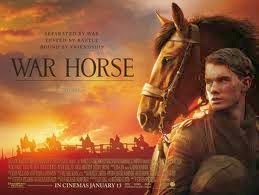
"War Horse" is the first Steven Spielberg film to be edited digitally. He was the final holdout who manually cut actual film on a flatbed editing board. This move to the modern seems odd since everything else about the production feels like it comes from a earlier time. Handsomely mounted and utterly sappy, "War Horse" is the director's least successful picture since "The Terminal"; it has its moments, but they are undercut by a complete lack of faith in the audience not trusting them to find the emotiona beats but being lead to them by John Williams' bombastic score.

The film is based on the novel by Michael Morpurgo, which also inspired the current Broadway play. It is the story of Joey, the war horse of the title, and Albert (Jeremy Irvine), the boy who raises him, trains him, and loves him. The film takes its time getting the horse to war; the first quarter or so of the film concerns the horse's formative time, as Albert attempts to make Joey into a plow horse, and thus save his family farm. In these village and farm scenes, nestled in lush, rolling hills, Spielberg is clearly aping John Ford's "The Quiet Man", but the lovely visuals are constantly undercut by Williams' musical swells.

As the parents, the venerable character actors Emily Watson and Peter Mullan give their stereotypical roles some weight. Dear old Dad drinks too much and allows his pride cloud his judgement. Mum is wise and steadfast. Due to various calamities the family is forced to sell Joey to the British army at the outset of World War I. We then follow Joey on his travels: from the British army to the Germans, to a French farmhouse, back to the Germans, and, well, you can probably guess the finale. It's one of those international movies where the German soldiers and the French peasants all speak English, rendering a line complimenting a German soldier's grasp of the language into a bit of a head-scratcher.

The film is visually gorgeous, every frame is a pretty picture; we'd expect nothing less of Spielberg and his regular cinematographer, the great Janusz Kaminski. They fill the film with elegant compositions (the shot with the windmill blades is masterful) and infectious warmth. But they're also altogether too reliant on the crutches of Spielberg's style: the hero angle and big, slow, low-shot zooms--there are probably as many of both.

The battle scenes are brilliantly staged, though once Spielberg gets to the trench warfare, he appears to be repeating cues from "Saving Private Ryan" over a dozen years ago but none of the sequences carry the weight of the earlier film. In addition, the stakes are far lower--the film is so conventional that we're fairly certain how it's going to turn out so there's not much suspense. There, and elsewhere in the third act, the film only shines in the pauses.

One of those pauses is the picture's best single scene, which finds a British and German soldier coming together in no mans land. This is a small, human, funny, and rather remarkable encounter, and it's so well observed and believable that it only draws our attention to how phony the rest of the film is. Some of that's the writing; some of it is the director's too-presentational staging. But much of that is Williams's overstuffed and nonstop music, which can take even the most finely-tuned encounter and slather it in so much string-assisted artificiality as to render it all into Hollywood pap.

There are moments, here and there; the way the Frenchman protects his granddaughter, the horse's climactic run and the real emotion worked up in the third act. "War Horse"offers many pretty pictures, some excellent scenes but falls short.

Thursday, December 29, 2011

Fincher Redo

Does the world need another adaptation of Stieg Larsson's novel "The Girl with the Dragon Tattoo"? Probably not. After all there all ready exists a Swedish language miniseries that was trimmed for theatrical release that made over $100 million worldwide and featured a searing performance by Noomi Rapace.  But Americans hate subtitles so an English language version was inevitable. Luckily the task was given to  director David Fincher. While the material is not fresh, thanks to the phenomenal performances and visual style, the movie remains engaging and extraordinary in its own way.

The film centers on Mikael Blomkvist (Daniel Craig), a journalist who loses his credibility and life savings after being found guily of libel. Utterly lost, Mikael is approached by wealthy industrialist Henrik Vanger (Christopher Plummer) with an unusual opportunity: Vanger wants to know the fate of his niece who disappeared over 40 years earlier and believes that Mikael can solve the mystery. On the other side of the story is Lisbeth Salander (Rooney Mara), an anti-social goth who does investigations for a security firm and is a ward of the state who suffers at the hand of her sadistic legal guardian (Yorick van Wageningen). The stories merge when Mikael hires Lisbeth as his assistant and launches his investigation, discovering that the Vanger family houses some dark and terrifying secrets.

Fincher has never shied from the more uncomfortable or challenging elements of a story, be it the ritualistic murders city in "Seven", the nihilistic brawlers in"Fight Club", or the true life violence in "Zodiac", and it serves him perfectly in his execution of"The girl with the Dragon Tattoo". The tone is unabashedly twisted and grim, but the content is never gratuitous or alienating. Every scene of brutality, there are many, serves to either inform the audience about the characters or advance the plot. Even Jeff Cronenweth's cinematography have a hushed, grim tone; the exterior shots showcase Sweden's beautiful snowy landscapes, while interiors are gray and ominously lit, reflecting the dark secrets hidden by the Vanger's wealth. 

Fincher reunites with Trent Reznor and Atticus Ross, who wrote the Academy award winning score for "The Social Network." The film opens with a stunning title sequence set to Reznor and Karen O's cover of Led Zeppelin’s “Immigrant Song” that will jar some movie-goers. Reznor and Ross employ an industrial sound with a minimalist approach that blends perfectly with Fincher’s style. Hopefully this director/composer team continue to work together. 

Aided by her limited exposure prior to this film, Rooney Mara is able o disappear into Lisbeth. Dressed all in black, her hair cut short and dead eyes, Mara captures the subtleties of Lisbeth – from her intense gaze to her physical tension when around strangers – and her violent and more emotional moments, such as when she takes revenge against her guardian. There was some concern that the actress wouldn’t be able to hold her own against Rapace’s interpretation. Mara does equal and sometimes exceeds her. 

Unlike Mara, Daniel Craig doesn’t have the benefit of being a new face, and is, instead, identified almost universally as James Bond. But like his female co-star, Craig is successful in masking himself as Mikael in both the character’s strength and extreme weakness. As the movie isn’t an ensemble piece, most actors outside of the two leads don’t have much time in the limelight, but there isn’t a single miscast performer in the group. Van Wageningen is excellent to a disturbing level, while Plummer plays the tortured Henrik Vanger with aplomb. Even supporting players like Stellan Skarsgard and Joely Richardson are captivating in small but crucial roles.

Though some story details do fall through the cracks, Steve Zaillian’s script and Kirk Baxter and Angus Wall’s editing keeps the 158 minute film working at an impressive pace. The story does meander a little in the last 15 minutes but that is due to the nature of adaptation. "The Girl with the Dragon Tatto" may not be  David Fincher’s best work but it is well worth seeing.

Sunday, November 6, 2011

Quirky Teen in Wales

The oddly titled "Submarine" tells the tale of Oliver Tate is a boy growing up in Wales in the mid-1980s who sports a shaggy haircut that makes him look like he just stepped off the cover of a 1960s record album. He also looks Bud Cort from "Harold and Maude, " a nice bit of serendipity since the movie is so reminiscent of Hal Ashby's classic. Replace Cat Stevens songs with new numbers from Arctic Monkeys-frontman Alex Turner, make the romance age appropriate, and you've got a pretty good idea what"Submari" is all about. Which is to say that it is a good movie that never quite transcends its influences.

Twenty-year-old actor Craig Roberts takes the lead as Oliver, an imaginative adolescent with adolescent concerns: mortality, peer acceptance and girls. Oliver daydreams the movie of his life and then outlines meticulous plans to make those fantasies come true. Dream #1 is Jordana Bevan (Yasmin Paige from"The Sarah Jane Adventures"), a cute gal who likes the occasional mayhem. Oliver will resort to a little bullying to prove to his mettle and win her heart. Despite a strong desire to be different Oliver is influenced by his surroundings. He has attempted many affectations to change other people's perceptions but most of his efforts have been cribbed from old movies and American soap operas. He stares at the sea like a Romantic Age poet because he saw a film that asserted this is what great thinkers do. Still, no big answers seem to come back from the emptiness.

Oliver's young life is complicated by a growing distance between his parents. Sally Hawkins plays the mother, Noah Taylor plays the father. She once wanted to be an actress, but now works in government administration; he is a marine biologist whose suffers from chronic depression. He describes the mood as being akin to submersion and that is where the movie gets its title.

"Submarine" was adapted from Joe Dunthorne's novel by and is the directorial debut of Richard Ayoade who is better known as an actor, particularly his role as Moss on the British sitcom "The IT Crowd."  The aforementioned "Harold and Maude" and the works of  Wes Anderson (especially "Rushmore" and "The Life Aquatic") can be seen as influences on the film. The dead pan dialogue, off kilter characters, formalistic framing and quirky voiceover place the film squarely in the minute genre of darkly comedic coming-of-age tales starring morbid teen boys who attempt to act above their age. It doesn't reach the heights of those earlier efforts but it is the first attempt from a talented new director.

Director Richard Ayoade on location


Sunday, October 16, 2011

Dark Irish Comedy

Gleeson enjoys an actor's life
A typical Hollywood formula is to combine a white guy and a black guy with completely different personalities, add a murder mystery that needs to be solved or drug smuggling ring that needs to be busted up, have the pair bond over some explosions, sprinkle with witty quips and sit back as the masses storm the multiplex. Now writer/director John Michael McDonagh has taken that brew, given it an Irish twist, and created one of the best comedies of the year.

Featuring great turns by its stars, terrific chemistry between its leads and an unorthodox approach to a familiar set-up, "The Guard" is a hilarious politically incorrect comedy with heart.  The story centers on Sergeant Gerry Boyle (Brendan Gleeson), a police officer who serves in the West of Ireland. Upon learning that a team of three international drug smugglers (Mark Strong, Liam Cunningham, David Wilmot) are in town, Boyle is forced to team up with an FBI agent named Wendell Everett (Don Cheadle) in order to bring them to justice. Though initially Boyle is more concerned with "whoring and drinking" he and Everett are unified against a wave of corruption, bribery and blackmail. 

The greatest reason for the film’s success is the pairing and dynamic between Gleeson and Cheadle. Because their characters are so deftly written and layered, all aspects of Boyle and Everett’s personalities bounce off each other perfectly without ever feeling like a tired retread. From Boyle’s casual racism to Everett’s wealthy upbringing; Boyle’s lack of worldliness to Everett’s fish-out-of-water situation, everything about the two is crafted with purpose and wit.  Gleeson is required not only to be a bit of a schlub who, but, thanks to scenes with his dying mother, also a good and responsible man. The range shown in each actor’s performance is absolutely brilliant. The film’s real scene stealer, though, is Mark Strong as a criminal who has become bored by what he does. Strong has been typecast as the stereotypical villain in some major productions and here he shows that he can play deep and complex characters when given the right material.

Some audiences won’t take kindly to McDonagh’s brazen and unabashed approach to comedy, but those that are appreciate irreverent humor and like feeling a little bad when they laugh are going to absolutely love "The Guard."

Tuesday, July 12, 2011

From the Big Bang to Texas in 138 minutes.

Terrence Malick's latest opus "The Tree of Life" has split movie going audiences into two camps. The walkouts who have little patience for the type of arty, obscure film-making on display and the excessively appreciative acolyte who thrill to have a reprise from the summer mindless blockbuster.   

The story is simplicity itself, something that is perhaps obscured for some by the nonlinear approach. what appears to be its alien approach: Architect Jack O’Brien (Sean Penn) experiences the anniversary of his brother’s untimely death with considerable anguish and difficulty, as seen through a series of reveries that puts him in touch with memories that connect him to the origins of life itself even as he is drawn back to recalling specific episodes from the days of his uneasy childhood in 1950s Texas.His father (Brad Pitt) is a difficult man to love, as he is strict disciplinarian, demanding perfection in every task.  Jack's mother (Jessica Chastain) is the parent he and his two brothers find much easier to adore, as she is nurturing, forgiving, and generous.
Young Jack (Hunter McCracken) is a boy we see growing to resent the treatment he receives from his father, even as he begins to suffer the consequences of it by becoming more and more like him every day. His father tells him “you can’t be too good” to succeed in the world, and as the boy appears to move towards embracing that advice against his own better judgment, he becomes still more aware of how the opposite nature of his mother continues to “wrestle inside” his heart.
 
Malick makes a concerted effort as the film unspools to break down some of the barriers of what we would normally think of as the natural progression of a story’s time line, so that towards the end of the film, past, present, and future all appear to be engaging one another in gestures of deep recognition and awareness. Some viewers have interpreted the key scene where this happens as Malick’s vision of the “afterlife,” but there are sequences that follow that clearly indicate—at least to me—that it is instead the moment of spiritual catharsis that adult Jack’s memories and internal suffering have been building toward through the entire film.
If this story sounds very traditional, it should, because it is. It has to be, in order not to interfere with what I took to be Malick’s genuine purpose, which is to ask the viewer to not become just emotionally involved, but to thoughtfully interact with the religious and philosophical matters of his concern.
 
Opening with a Biblical quote pertaining to God’s response to Job (which we will read very easily as analogous to the experiences of every character), Malick then offers us an opening voiceover that is 100% the key to understanding everything that is to come:
 
There are two ways through life: the way of Nature, and the way of Grace. You have to choose which one you'll follow. Nature only wants to please itself. Get others to please it too. Likes to lord it over them. To have its own way. It finds reasons to be unhappy when all the world is shining around it. And love is smiling through all things. Grace doesn't try to please itself. Accepts being slighted, forgotten, disliked. Accepts insults and injuries.
 
To be just a little reductive, allow me to spell it out: Nature = Brad Pitt, Jack’s Dad.  Grace = Jessica Chastain, Jack’s Mom.
 
Jack, as the adult child of these warring influences, struggles to choose the proper path that will help him to cope with the loss of his brother and reconcile his complicated relationship with his father. The Job passage makes clear that this dialogue is taking place between the characters (through not just Penn, but through Pitt, Chastain and McCracken) and their concepts of God, which is how the creation footage is brought into play.The footage mostly takes shape in an extended sequence that includes the Big Bang, the heaving volcanoes,  the evolution of cells and the much talked about appearance of dinosaurs. The viewer is meant to extend the nature vs. grace argument through Jack's parents and to the difficulty with the paradox in the concept  of a Supreme Being who appears both all-loving and indifferently cruel. Jack's parents are his creators. Within him the paths of nature and grace are jockey for lead position, both exert influence over him. Malick's film uses the simplest of stories to convey the largest of questions.The characters are demanding - sometimes literally, sometimes through suggestion and symbols - How? Why? Answer me. 
 
The film's technical achievements are beyond reproach.Emmanuel Lubezki's cinematography is the front runner for this year's Academy Award. The performances are quality (Pitt is effective as always, Chastain does wonders with little dialogue, the children are delightfully unaffected, naturalistic.) Not every choice please me; Penn's screen time seemed too minor, given it's his dlemma that we are initially believe will be the spine of the film. I should admit that I first thought the final shot - don't worry I won't spoil anything - to be shockingly banal, only to realize a short time later just how appropriate it really was, and how Malick lets the audience know, in those final frames, how they might lessen the internal burdens by making a  connection.