Tuesday, January 4, 2011

Early Mann

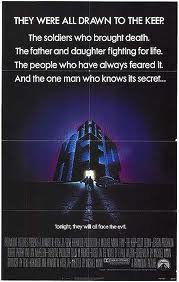
"The Keep" is the kind of film where unless you've read the book it was based on, you can forget about finding a narrative plot. It's based on a novel by noted horror writer F. Paul Wilson, the first in his six book Adversary cycle and the story probably makes more sense in book form. The book was a  best seller so it makes perfect sense to turn out a motion picture. Michael Mann, fresh from 1981's "Thief", adapts the screenplay, assembles a cast that includes some very interesting actors, gets several million dollars from Paramount, and heads off to England. The end result holds together quite well for about twenty minutes, bringing the German Army (under the command of Captain Klaus Woermann, played by Jurgen Prochnow) to an isolated area in the Carpathian Alps of Romania, which consists of a village and a terrifying fortress called, simply, the Keep. Some foolish soldiers who really should pay more attention to the creepy-old-guy-who-looks-after-the-place start messing around looking for treasure and unwittingly release an evil force from its millennium-long imprisonment. This happens in a jaw-dropping sequence that appears to be a six-hundred foot tracking shot through mid-air. Then some special effects happen, and before you know it, the movie falls completely apart.       

The movie ran over budget, Paramount stepped in, took final edit away from Mann and made the film incomprehensible. The SS (led by Major Erich Kaempffer, (Gabriel Byrne, in his motion picture debut) comes in due to the deaths of German soldiers blamed on rebels but actually the work of the creature. Then they bring in Dr. Cuza (Ian McKellen giving what maybe his worst performance ever) and his daughter Eva (Alberta Watson, the mother from "Spanking the Monkey".)  Then a mystical warrior shows up, and it's Scott Glenn. He's inscrutable, he doesn't have a reflection, and he looks like he's been directed to act like he's on serious medication. He and Eva embark on a tantric sex thing before they've even really spoken to one another, and the good doctor is healed by the evil force, but he doesn't think it's an evil force. Plus, there's a priest in the village and he was a friend of the Cuzas, but then he isn't. Periodically, a very serious, intense argument will break out between characters that seem to be straining for some form of political or sociological weight, to no avail. Prochnow has several shouting matches with Byrne about why he hates totalitarianism, which I'll leave for the political scholars to puzzle their way through. 

The two main adversaries of the piece are not mentioned by name until the last four minutes of the film, and even then only in passing and only once. There is no discipline, narrative or otherwise, which could possibly hold together the last seventy minutes of this film. Author Wilson was so disgusted with the end result that he wrote a short story, entitled "Cuts", about a horror writer who uses voodoo to kill a director who'd misadapted one of his stories. 

And yet this film is never anything less than captivating. Part of this is due to the unique score by Tangerine Dream. It swirls, thuds, and suffuses the frame with an eerie, electric beauty that is quite suitably epic in tone. In addition to that, Cinematographer Alex Thomson is a genius with light, filling the anamorphic frame with an eerie and beautiful incandescence. There are several shots in this film that are quite breathtaking in terms of composition, lighting, and fear-laced beauty. The effects are a mixed bag, though since it's 1983, thankfully there is no CGI. The use of traveling  mattes and reverse-fog is excellent, as are the five or six different ways that Nazis are shattered like china dolls. The excess of lasers at the end seems a little too disco and not as climactic as it doubtless was intended. 

If  Mann holds to his pattern of going back and recutting all of his films (which he has done for all of his features except "The Insider" and this one), perhaps one day we will see a version of "The Keep" that actually makes sense.  But until then, a small but vocal internet cult  will ensure that some people will find their way to "The Keep"  every now and then. The film has not received a official DVD release but is currently available on Netflix streaming. 

Sunday, January 2, 2011

Magic Bullet Theory

If you've only seen Edward G. Robinson in gangster films, give "Dr. Ehrlich's Magic Bullet" (1940) a chance and see his range as an actor. Here he portrays German physician and researcher Paul Ehrlich, a pioneer at the turn of the 20th century in the treatment of infectious diseases and the man who found a cure for syphilis. Ehrlich starts out as a general practitioner employed by a hospital in order to provide a stable living for his family but whose real love is for research. His inquiring mind and nonconformist views ultimately makes him a leader in his field, but not before his pioneering ideas get him in trouble with the medical establishment in his country. Robinson has excellent support here with Ruth Gordon playing Ehrlich's adoring wife. Otto Kruger ably portrays Emil Adolf Von Behring, Ehrlich's friend and colleague who find himself at odds with his good friend's professional ideas at one point in their careers.

The film was controversial at the time for mentioning the disease "syphilis" by name, and I'm sure a little bit of sensationalism is why Jack Warner thought that Dr. Ehrlich's biography would be good material for a film, but there's something more subtle going on here. Made in 1940, after the Nazi menace had been recognized by many but before America had been attacked, there are many not so subtle digs at Germany to be found here. Early in the film several of Ehrlich's colleagues are ratting him out to the head of the hospital for not following hospital rules. Specifically, Ehrlich realizes that the sweat baths prescribed as the treatment of syphilis at the time - 1890 - are of no value whatsoever. When a patient of Ehrlich's says that the baths sap his strength and may cost him his job, Ehrlich says that he can skip the baths. This humane act of deviating from a useless treatment is the "rule" Ehrlich has broken, and what gets him called on the carpet by the head of the hospital. The whole incident is one of several that make the Germans look rigid and inhumane. The issue of Ehrlich's colleagues doubting his abilities because of his religion - he was Jewish - also comes up a few times. Finally, when the state budget committee that is financing Ehrlich's lab comes by for an inspection they chastise Ehrlich for hiring a "non-German" doctor. It's very effective but subtle criticism of the Germans that Warner Brothers did so well in the years leading up to the war.

One bone that Warner Brothers did have to throw to the censors because of the open discussion and showing of syphilis patients in various stages of the disease is that they could not show any female patients. They were only allowed to show male sufferers. I guess these guys all got this from "an inanimate object" as Dr. Ehrlich says is possible at one point in the film to downplay the sexual transmission angle of this disease.

Saturday, January 1, 2011

Royally Tongue Tied

At it’s heart, director Tom Hooper's  "The King’s Speech" is an old-fashioned buddy movie. The Duke of York, second son to King George V, is not expected to become king, and thankfully so, because he is afflicted with a stammer. On the other hand is Lionel Logue, an Australian immigrant and speech therapist, an eccentric who loves Shakespeare and has odd ideas about how to cure his patients.

The film bears all the trappings of a typical, Oscar-bait, Masterpiece Theater-type entertainment. It’s exceedingly British, with all the costumes and sets that that entails. We have locations like Buckingham Palace, Westminster Abbey, and Balmoral, along with the muted photography by Danny Cohen, perfectly represent the 1930s time period. But what raises the film above all this is the human emotion that bubbles to the surface thanks to a perceptive script by Danny Seidler, and two first-class performances from Colin Firth and Geoffrey Rush.

Firth, who might as well compose his Oscar speech now, manages to navigate the tricky part by presenting the Duke as an underdog determined to rise to the challenge yet frightened that if he fails, the whole country could be lost to the charismatic Hitler.

Rush has an easier part, technically. He has all the good lines and Rush, given some shading by Seidler’s script, brings the man to life. We get a key scene when he auditions for Richard III at a local theater group and is basically insulted for being too old and too Australian.

The third piece in this film is Helena Bonham Carter as Elizabeth, the Duke's steadfast wife who was beloved by the public and is portrayed as the pinnacle of the British stiff upper-lip. the role maybe underdeveloped but Bonham Carter is eminently likable in the role.

Also making small but effective appearances are Michael Gambon as the old king, Derek Jacobi as the Archbishop of Canterbury and Guy Pearce as older brother David, the abdicated king, who is a largely reviled figure in history, but Pearce, along with the script, cuts him some slack (there are a few veiled references to his Nazi appeasement).

The film's climax is well known history but Hooper manages to invest the scene with a great deal of well-earned pathos. 

Thursday, December 23, 2010

My Favorite Version Of A Holiday Classic


In 1992, it had been eight years since the Muppets had last graced the silver screen and two years since their founder Jim Henson had passed away from pneumonia. Henson's sudden, unexpected death put off a possible sale of Kermit and friends to the Walt Disney company, but the Muppets still wound up at Disney for their next feature film production. Rather than devise an original story as had been done for the Muppets' first three theatrical outings, the creative talent behind the project turned to a classic, much-adapted piece of literature, Charles Dickens "A Christmas Carol." Among the key players bringing the film to the screen were longtime head writer of "The Muppet Show" Jerry Juhl (penning the screenplay), longtime collaborator Frank Oz (serving as executive producer and Muppet performer) and Jim Henson's son Brian (as a producer and making his feature film directorial debut).

With a source text that had been brought to both the big or small screen hundreds of times, could the Muppets bring anything new to the table? The revolutionary thing that this adaptation would do is remain remarkably faithful to Dickens' words. Juhl's screenplay casts likable weirdo Gonzo the Great as a storyteller who claims he is Charles Dickens himself. This allows large chunks of Dickens' prose to be used as narration. As his sidekick, streetwise Rizzo the Rat provides physical comedy to keep things from getting too dark and dreary and also acts as designated audience spokesperson. Together, they are our guides to what is a greatly entertaining revisiting of the 1843 book.   

At its heart, Dickens' immortal novel deals with pretty dark and weighty themes, which may seem out of place for the happy-go-lucky Muppets or any G-rated movie at all. But "The Muppet Christmas Carol" is an entertaining, moving, and remarkably atmospheric motion picture which transcends the prior expectations of a Muppet movie and stands as one of the best adaptations of the perennial tale.  The movie holds up to repeated viewings (it is an annual Christmas tradition in my house) and  delights viewers young and old alike. Caine deserves credit for bringing such a thoughtful, realistic performance as Ebenezer Scrooge. 

With the father of the Muppets gone, a dramatic, frequently-filmed text as a starting point, and the gang's self-referential, free-wheeling comedy style toned down "The Muppet Christmas Carol"  defies the odds and delivers one of the best holiday films. Needless to say, fans of either Christmas, the Muppets, Dickens, Disney or movies in general should make room in their hearts (and their DVD collections) for this excellent film.  
God Bless Us, Everyone.

Monday, December 20, 2010

Not for the Squimish

Filmmaker Danny Boyle is a risk taker. Some have worked ("Trainspotting," "Millions"), others have failed ("A Life Less Ordinary," "The Beach"), but he's remained a captivating, intrepid presence on the movie scene. "127 Hours" is perhaps his most astonishing work to date, bringing to the screen the staggeringly nightmarish true story of Aron Ralston, who found himself literally between a rock and a hard place as he fought for his life in the wilds of Utah for just over five days. Boyle uses all of his skill to make a compelling film out of this one man show. 


While "Slumdog Millionaire" was a romanticized depiction of fate, "127 Hours" brings Boyle back to Earth. This is a harrowing story of endurance, with a full commitment made to Aron's most primal urges and thoughts during his near-weeklong ordeal. Fearlessly, Boyle plunges into the mix, providing a scattered, intimate view of the situation. Boyle splashes the screen with visual flair, and the majority of the film creates a visceral, insightful experience, putting the viewer inside the claustrophobic head of a man who cannot move, trapped in a desolate place. Sustaining despair is not an option here, and Boyle keeps the film to a upbeat tempo through bold cinematographic choices and a series of jubilant soundtrack cuts. 

It might be hard to imagine how a script with such limited scope could remain interesting for more than 90 minutes, but trust that these talented people have figured out how to do it. Fair warning, though there are scenes that are not for the squeamish but the film is never gratuitous or exploitative, but it does feel very real. The fact that you grow to like Aron (thanks to James Franco's stupendous performance) means that the physical anguish has tremendous emotional impact. "127 Hours" is a genuine must-see. 

Sunday, December 19, 2010

Dancing on the Edge

Darren Aronofsky’s trippy, hallucinatory, sexual and psychological opus moves to its own intense rhythm. It defies expectation and busts convention while embracing Douglas Sirk levels of melodrama.  Working from a deceptively simple script written by Mark Heyman, Andres Heinz and John McLaughlin, Aronofsky continues to dives into the world of the human psyche. Whether he’s dealing with genius ("Pi"), drug abuse ("Requiem for a Dream") or aging dreams of athletic glory long gone ("The Wrestler") Aronofsky concentrates on character allowing his striking visuals to boost the emotional connection.  Portman is extraordinary. She enters an emotional minefield so complex and layered that you wonder how she came through filming intact.

And yet, part of me still feels distant from this. There is a slight disconnect, something keeping me from embracing the picture as fully as I’d like. Don't get me wrong. This is a sensational piece of work containing what I think maybe the performance of the year. It is a movie I cannot wait to see again and the longer I think about it the more positive I am this is a psycho-sexual new age ballerina masterpiece close to being on par with "The Red Shoes." Aronofsky has challenged me, moved me and perplexed me, making "Black Swan" a dreamlike enigma I can’t wait to devour again.


Saturday, December 18, 2010

Voldemort Strikes Back

"Harry Potter and the Deathly Hallows" begins the conclusion to the wizard's saga. The seventh book in author J.K. Rowling's magical opus has been chopped into two feature films to properly tell the story, and capture some additional box office dollars. The movies have become Cliff Notes versions of the novels, providing the proper plot while lacking the shading and detail present in Rowling's writing.

Director David Yates and screenwriter Steve Kloves use the additional time to concentrate on the characters and force them from the safety of Hogwarts and into the treacherous Muggle world. Instead of the comfy corridors of their familiar school, Harry, Ron and Hermione trek through forbidding forests and inhospitable coastlines in their search for the remaining Horcruxes. The locations bring a new reality to our heroes and open the scope of the pictures that had begun to feel stuck in the studio.

The film earns its PG-13 rating by raising the dramatic stakes, as beloved characters are killed off unexpectedly and sexual jealousies threaten the trio's unity. There are furious wand shot-outs,including a standout magical gunfight in a London cafe where Harry realizes that there are no safe havens.

While there's plenty of room to tell a bleak story of impending war, Yates and Kloves equally appreciate spots of silent reflection, giving characters the opportunity to sit down and contemplate the journey ahead, with the passage of time emphasizing the doubt that is developing within them. Previous films would have jettisoned these moments, but the film is richer with their inclusion. After six movies at breakneck pace, it's refreshing to sit with Harry and observe him coming to terms with his fate, while offering unexpected acts of friendship (and impromptu dances) with those close to him.

The trio of actors has matured into their roles brilliantly and it has been a pleasure to see them improve in their craft. Radcliffe and Watson show a maturity and emotional range beyond their years and Grint has become comedic gold. A horde of famous faces return to fill out the community of wizards, villians and ghouls, though nobody sticks around very long.

"Deathly Hollows" remains an engaging fantasy film, with a suspenseful set-piece where our heroes infiltrate the Ministry of Magic and a unique animated sequence that explains the origin of the titular objects. The audience is given "The Empire Strikes Back" ending that finds Voldemort at the height of his powers.  This nervy entry in the franchise wisely matures with the fanbase and builds some momentum for the furious final stand .